
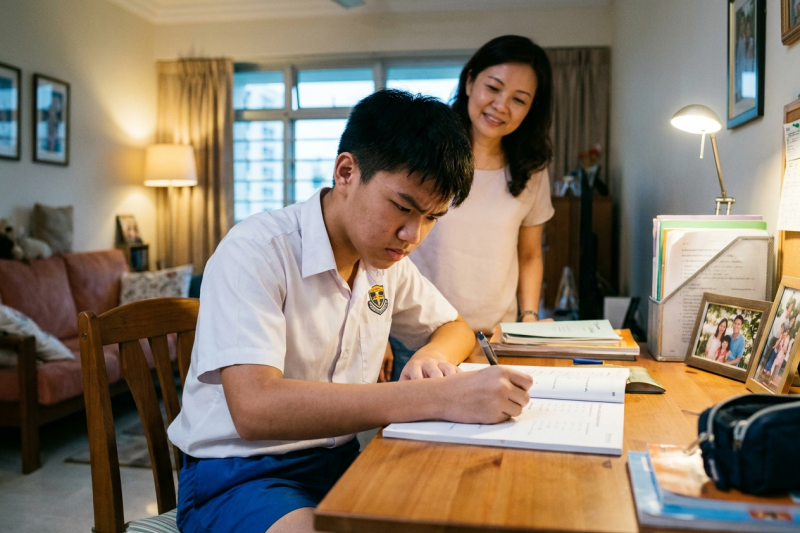
The first few weeks of secondary school tend to feel like a lot of things at once. New uniform. New friends. New timetable. New teachers with different expectations. Most parents are busy helping their child adjust to all of it, which is completely understandable.
Math, weirdly, is often the last thing that gets attention during this period. Partly because children rarely volunteer that they are struggling, especially when everything else is new and they are still trying to figure out where their classrooms are. And partly because parents assume that a child who did reasonably well in PSLE should be fine.
That assumption catches a lot of families off guard.
Secondary 1 math in Singapore is not a gentle continuation of what came before. It is a proper step change. The topics shift. The way questions are framed changes. The expectation around working and reasoning goes up considerably. And children who coasted through upper primary on memorised methods often find, sometimes quite suddenly, that those methods no longer work.
By the time the gaps are obvious, several months of foundation have already been missed.
What Actually Changes in Sec 1 Math
If you sat through PSLE math with your child, you already know the model method. Draw a bar. Label the parts. Work through the logic visually. It is a powerful tool and Singapore primary schools use it well.
Secondary school largely leaves it behind.
Algebra becomes the main language of problem solving from Sec 1 onwards. Children are expected to form equations, manipulate them, and reason abstractly in ways that feel very different from the concrete, visual approach of primary math. For some children, this transition clicks quickly. For others, it is genuinely disorienting.
Beyond algebra, Sec 1 also introduces geometry in a more formal way, including angle properties, triangle congruence, and geometric proofs that require a kind of logical, step-by-step written reasoning that most children have never been asked to produce before. Statistics, indices, and linear graphs also come in during the first year, depending on the stream.
The volume of new content in Sec 1 is significant. More importantly, almost all of it becomes the foundation for what comes in Sec 2, Sec 3, and eventually O Levels. Getting it right in the first year is not just about passing the end-of-year exam. It is about having something solid to build on for the next four years.
Why Children Do Not Always Speak Up
Here is something worth knowing about secondary school students, especially those in their first year.
They do not always tell you when they are lost.
Primary school children tend to be more transparent about not understanding something, partly because they are used to a closer relationship with their form teachers, and partly because asking for help feels more normal at that age. Secondary school shifts the social dynamics considerably. Admitting you do not understand something, especially in front of new classmates you are still trying to impress, feels different.
So they copy from friends. They leave blanks and hope the teacher does not call on them. They do enough to get by in class without ever really catching up on what they missed.
By the time a report card comes home with a grade that does not look right, weeks or months of confusion have already accumulated. And the child, who has been quietly managing the situation, has to admit not just that they are struggling, but that they have been struggling for a while.
This is not a character flaw. It is just what secondary school feels like from the inside for a lot of children. Knowing this as a parent means you do not wait for them to tell you something is wrong. You check in early, often, and without making it feel like an interrogation.
The Habits That Make the Biggest Difference in Sec 1
The children who navigate Sec 1 math well are not always the ones with the most natural ability. They are usually the ones who build the right habits early, before the content becomes genuinely difficult.
A few habits stand out consistently.
Doing homework the day it is assigned rather than the night before it is due sounds basic, but it matters more in math than in other subjects. Math understanding degrades quickly if you leave a gap between the lesson and the practice. Doing it while the class discussion is still fresh means mistakes get caught while the child still remembers what was being taught.
Writing out full working, even for steps that feel obvious, is a habit that pays dividends later. Secondary math marking is done on method as much as on final answers. A child who gets the right answer but shows no working loses marks. A child who makes an arithmetic error but shows clear reasoning can still pick up the bulk of the marks. This habit takes time to build and is much easier to establish in Sec 1 than to retrofit in Sec 3.
Reviewing mistakes properly, rather than just circling the right answer and moving on, separates children who plateau from those who keep improving. After every graded assignment or test, your child should be able to tell you not just what they got wrong, but why, and what they would do differently. If they cannot, they have not reviewed it properly.
When to Consider Getting Extra Support
Secondary school math moves at a pace that assumes everyone in the class is keeping up. When a child falls behind, the class does not slow down. The teacher cannot always stop and reteach a concept from three weeks ago when there is new material to cover.
This is where the gap between those who have support and those who do not tends to widen.
Getting outside help does not need to wait until your child is failing. In fact, the best time to bring in structured support is often before there is a visible problem, in the first semester of Sec 1, while the habits are still being formed and the content is still manageable.
If your child is already showing signs of difficulty, or if you want to make sure the transition from primary to secondary is as smooth as possible, it is worth looking at what good sec 1 math tuition in Singapore actually looks like. The right programme focuses on building genuine understanding of new concepts, particularly around algebra and geometry, rather than just drilling for the next test. Jimmy Maths does exactly that, and for children who found the jump from primary school harder than expected, that kind of structured, concept-first support tends to make a real difference.
What Parents Can Actually Do at Home
You do not need to remember secondary school math to support your child through it. What helps most is not knowing the content. It is creating conditions where learning can actually happen.
Keep an eye on the rhythm of their revision. Are they doing it consistently or in panicked bursts before exams? Consistent is almost always better. Short sessions, done regularly, build more durable understanding than long cramming sessions that leave the brain exhausted.
Ask them to teach you something they learned that week. This sounds strange but it works. The act of explaining a concept out loud forces a child to find the gaps in their own understanding. If they cannot explain it clearly, they probably do not understand it as well as they think. If they can, they have just reinforced it. Either way, you have learned something useful about where they are.
Notice the small wins. Sec 1 is a hard year for a lot of children, not just academically but socially and emotionally. Acknowledging progress, especially when it is not yet showing up as an A on a test, keeps motivation alive during the stretches when improvement feels invisible.
One More Thing Worth Saying
The transition to secondary school is a genuine inflection point. The choices made in Sec 1, around effort, habits, and getting help when it is needed, tend to shape how the next four years go more than most families realise at the time.
This does not mean the pressure needs to be unbearable. It means the first year deserves to be taken seriously, not in a way that adds stress, but in a way that sets your child up so the years ahead feel manageable rather than like catching up.
If math is the subject that is already giving them trouble, addressing it now, before the content gets harder and the stakes get higher, is simply the most practical thing you can do.
The earlier you act, the more options you have. And the more confident your child feels heading into Sec 2, the better the years ahead tend to look.